Andy Hertzfeld
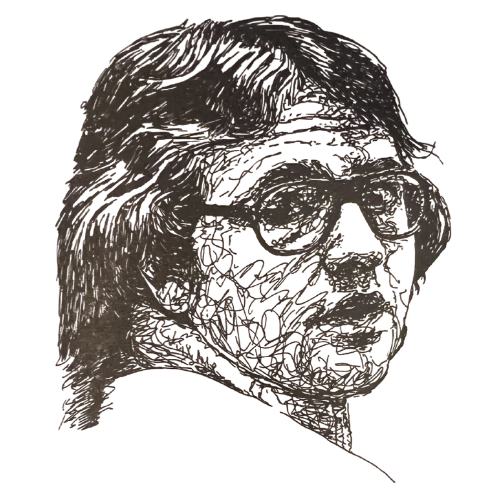
Andy Hertzfeld was a key member of the original Apple Macintosh development team, and a pioneer among PC software engineers. From the early days of Apple Computer through his later work with Radius, General Magic, Eazel, Google and the Open Source Foundation his key contribution has been making computers easier and more fun to use. Hertzfeld's Apple Computer business cards listed his title as "Software Wizard" and he continues in that role of wizard to this day whether through his work or in the time he enjoys playing with his grandkids.
You will find in the interview from 1985, Hertzfeld is a terrific storyteller with a generous spirit. He continues now to do a great deal to share and preserve the history and stories of the pivotal PC era through his web sites and archives, documentary films, and elsewhere. He is one of the few programmers from my book portrayed as a character in movies. In the film “Steve Jobs” (2015), he is depicted as a close, often worried friend to Steve Jobs, providing a sense of levity amidst the chaos of product launches.
Excerpts from the 1985 Interview in the Book
“The door was open at dusk when I walked up to Andy Hertzfeld’s small, cottage-style house on a side street close to downtown Palo Alto. I walked into a dimly lit room where I heard Andy talking on the phone. He spoke in an animated, upbeat voice while he sat on the sofa, barefoot, clad in jeans and a T-shirt, with one leg tucked underneath him. He was a short, heavy-set, slightly tousled young man with a friendly, relaxed demeanor. He smiled and waved me into the room, pointing toward a chair, all the while talking to the person on the other end of the line.
I took a seat and observed my surroundings. We sat in a rather large, open, front room furnished with a large sofa and one chair. I tried to turn on the lamp next to me, but it did not work; so we sat more or less in increasing darkness as the sun set. Two bookshelves filled to the brim with books stacked both upright and sideways, a synthesizer, a Macintosh, and a stereo stood against the walls. The room was slightly unkempt but in no way dirty. Andy later explained that he is extremely messy, but I was lucky because I happened to come on the one day the house is clean, the day the cleaning lady comes. With little delay, Andy hung up the phone. In his talkative, friendly manner, he discussed candidly his career as a programmer, delving into both the good and bad times at Apple, and explaining his approach to programming. More than anything else, Andy stressed that he programs because it is fun, and when it is no longer fun he will move on to something else.”
“INTERVIEWER: Can you pinpoint the period in your career when you became enamored of personal computers?
HERTZFELD: The big event for me occurred in March 1977 at the first West Coast Computer Faire. It was very exciting because it was the first real gathering of the clans in an industry that was just starting out in the area. I saw the Apple II for the first time, and I said, “That’s the one I want.” It was real sexy. A computer with graphics would have been enough, but the Apple II had color graphics, and that blew my mind. Unfortunately, those Apple II’s were kind of expensive, and I couldn’t afford one. Finally, in January 1978, Apple had a “$400.00 off” sale, so I bought one. It’s usually true that reality can’t fulfill expectations, but the Apple II was twice as good as I ever thought it could be. Buying that machine was the best single purchase of my life.
A computer gives an amazing feeling of control and power to a kid. I tried to make personal computers the topic of my graduate-school research, because to me they were the most exciting machines in the world. I was amazed that almost every professor in the department thought personal computers were the worst thing that ever happened to computer science. So I lost interest in my courses during my second year of grad school. I just wanted to play with my Apple.
INTERVIEWER: Why were the professors against personal computers?
HERTZFELD: Because personal computers were less powerful and had less memory than the big computers they were programming. They thought personal computers were moving computing back twenty years. They just hadn’t caught on to the thrills that ordinary people can have on these machines. Suddenly computers were within the reach of everyone. I guess a lot of academics couldn’t have cared less. I didn’t care that personal computers had 1/100th of the memory that the bigger computers had. They were so much more fascinating, and they only cost a thousand to two thousand bucks. And so I started teaching myself about the Apple II. In April 1978, I became a charter member of the first Apple users club in the Bay area. That was a place to show off your programs and get other people’s programs.
INTERVIEWER: When did you start taking programming seriously?
HERTZFELD: It wasn’t until I was in my junior year in college, majoring first in physics and later in math, that I started thinking, “Oh my God, I’m going to have to choose what to do with my life.” I didn’t want to wear coats and ties and be a part of the corporate structure. Then, for a while it was a case of, “Oh my God, I’ll never be able to find a job doing anything.” Then, when I found that the graduate math courses were really hard, it became, “Oh my God, I hate my major,” and my intended career as a math professor started sinking out of sight. Programming didn’t occur to me as a career choice. It wasn’t a career in those days…
…You see, as a programmer I always liked getting to the bottom of things, working my way down to the most fundamental level and understanding everything…”
Interview Excerpt:
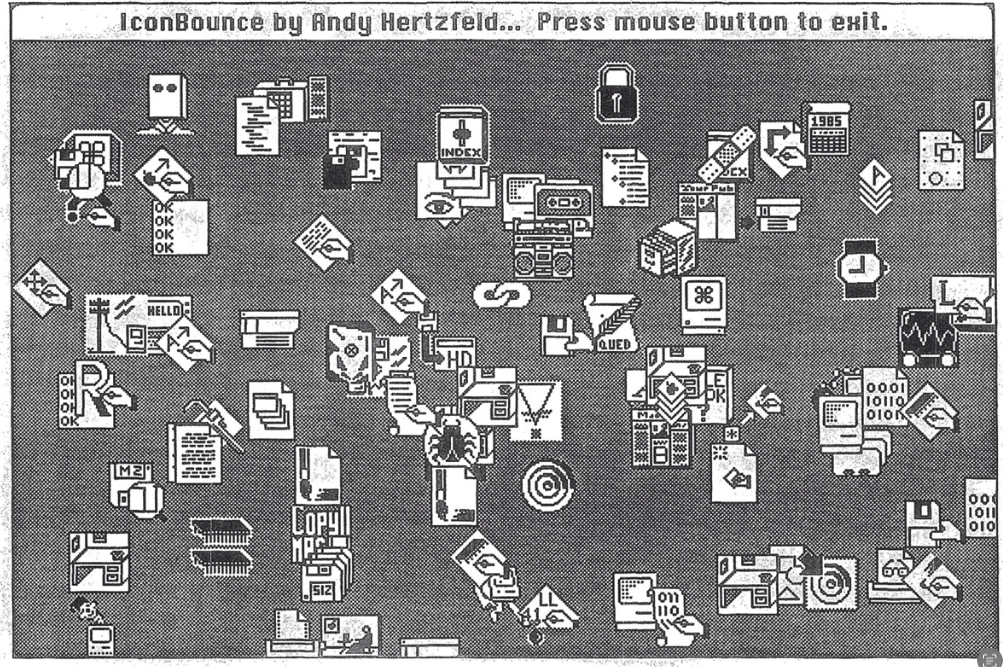
Below is a screen shot of a program Andy Hertzfeld wrote and included in the book. Icons will bounce on your Macintosh screen. Just key in the program found in the Appendix (pages 361–369).