Jef Raskin
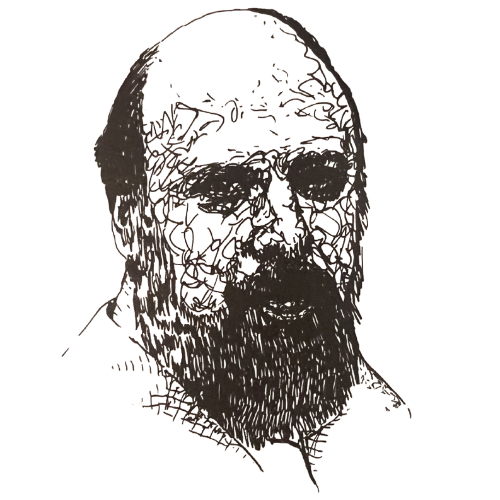
Jef Raskin (March 9, 1943 – February 26, 2005) is the human-computer interface expert who began the Apple Macintosh project for Apple Computer. He was a man of many talents. A past conductor of the San Francisco Chamber Opera Company; a holder of patents in packaging design, aircraft structures, and electronics; an artist whose work has been exhibited in the New York Museum of Modern Art and the Los Angeles County Museum; and a chief executive officer of Information Appliance Inc. He was born in New York City in 1943—as he put it, about the time the digital computer was born. He studied mathematics, physics, philosophy, and music and all those disciplines showed up in his work and larger than life personality. Jef’s vision of the computer’s need for a “humane user experience” as an “information appliance” which he describes in depth in the book took 40 years to emerge and is more essential today than ever before.
Excerpts from the 1985 Interview in the Book
“When told the title of this book, Jef Raskin was quick to point out that he wasn’t a programmer per se, but rather a designer or a “metaprogrammer,” and that his company is not involved with traditional software. Jef Raskin is a person who strives to distinguish himself from the crowd. He is an inventor with original ideas for new software and innovative ways to make microcomputers perform. He is not the person who sits down at the computer and writes the source code. This distinction between a programmer and a software or systems designer is becoming more and more prevalent as software becomes more complex and as more people are trained in the techniques of translating specifications into code.
The offices of Information Appliance were not like the elegant, ostentatious offices of many other software companies; they were, in fact, relatively small, somewhat dingy, and just plain ordinary. They could have been the offices of a small appliance company, and I presumed this was all part of Jef’s microcomputer philosophy.
Raskin is a very animated, excited, and excitable fellow. At certain moments, I felt I was in the midst of an amusement park; one minute Raskin would give an impressive demo of his new product as if performing magic tricks; a little later he would break into a juggling act; next, he would swing around and play a song on his synthesizer; and then he would send a little model car whizzing around on his desk, all the while discussing the past, present, and future of microcomputers. He has a vision of the role microcomputers should play: not one of glorious, mysterious, elusive machines, but one of invisible, easy-to-use, practical appliances.”
“INTERVIEWER: You’re best known for having created Macintosh at Apple. What role did you play?
RASKIN: In 1979, Apple was working on the Lisa. Believe it or not, it started as a character-generator machine. I was manager of advanced systems at Apple, and I was really unhappy with the Lisa. It was very expensive, and I thought Apple was foolish to tackle DEC, Data General, and IBM in the minicomputer price range. When I was a visiting scholar at the Stanford Artificial Intelligence Laboratory in the early seventies, I spent a lot of time at Xerox’s Palo Alto Research Center. I thought the work Xerox PARC was doing with bit-mapped screens, generalized keyboards, and graphics was wonderful. So I lobbied hard and got Apple to change Lisa to a bit-map machine. I helped put Xerox and Apple together. At one time Xerox owned about 10 percent of Apple stock.
I hired the original people: Bud Tribble, Brian Howard, and Burrell Smith. We went off to a different building and built prototypes of the Macintosh and its software, and got it up and running. Later, after he took over, Jobs came up with the story about the Mac project being a “pirate operation.” We weren’t trying to keep the project away from Apple, as he later said; we had very good ties with the rest of Apple. We were trying to keep the project away from Jobs’ meddling. For the first two years, Jobs wanted to kill the project because he didn’t understand what it was really all about….
INTERVIEWER: In the end, would you say your experience at Apple was a bad one?
RASKIN: No. The first few years, ’76 to ’80, were wonderful. I had a great time and have no regrets. In the early days, Jobs and Wozniak were a joy to work with. But then from late 1980 through ’82, working at Apple became a real nightmare for me…”
Excerpt 1:
“INTERVIEWER: So describe the idea that inspired you to create a new company, Information Appliance. How does the word “appliance” reflect the products you are developing? here?
RASKIN: Have you ever noticed that there are no Maytag user groups? Nobody needs a mutual support group to run a washing machine. You just put the clothes in, punch the button, and they get clean. To do information processing, I don’t want hardware and software; what I really want is an appliance to do my tasks. And what tasks do I do? Surveys show that 85 percent of all personal computer users use word processing, so I need a word processor, a wonderful word processor—the best in the world. But I am sort of simpleminded. I can only remember ten or fifteen commands. That’s why the system I use has only five. That way I can wake up at 3:00 a.m., get out of bed, go over to the computer, and just type out an idea.
INTERVIEWER: You mean you’ve tried to simplify a system or dumb it down?
RASKIN: Right. Let’s consider what it would be like if a computer company had designed a toaster. You wake up and you want a piece of toast for breakfast. […] “Then you put in the system disk and boot the system. After that you put in your breakfast disk and then you type “Load TOASTED.CODE.” Do you think it does anything yet?
Of course not! It’s designed by a computer company. It says “Are you sure?” Now you’re ready to throw it through the wall. Are you mad yet? Haven’t you been mad at computers for years? But because you spent a couple of thousand dollars on it, you put up with all this stupidity, and so does the rest of the world. Millions of people go through nonsense like this every time they use a computer…”
Excerpt 2:
“INTERVIEWER: Do you feel there is any parallel between music, the arts, and the computer?
RASKIN: Not a parallel. But I’m definitely trying to do things that will make people happy. One of the reasons I liked being a musician is that musicians have rarely done anything bad in the world. If you’re a physicist, you might invent something that explodes. But musicians never do. Artists can create propaganda posters but with musicians, it’s usually pretty neutral stuff. I have always been interested in doing something that would make lots of people happy.
INTERVIEWER: Do I detect a contempt for user-interface systems and manuals that don’t use simple English commands and text?
RASKIN: I usually can’t figure out what icons mean, but I can figure out what English words mean. It’s easier for me to translate English into Spanish and French than it is to make up icons that can be understood by everyone everywhere in the world. I’ve been working in this direction for a long time. It wasn’t until I got away from Silicon Valley and let my head clear for six months that I suddenly saw I’d been simply barking up the wrong tree.
INTERVIEWER: You mean you had been swept into a whirlpool of complexity there?
RASKIN: Icons, menus inside menus, windows, mice, big operating systems, huge programs, integrated packages. I would like to remind the world that just because two things are on the same menu doesn’t mean they taste good together.
INTERVIEWER: Is that your message to Silicon Valley? To show the creators of complex systems that there is a simple alternative?
RASKIN: Yes…It’s relatively simple. I asked myself the question: “What makes people form habits?” When I’m using a system, I’m happiest if I can keep my mind on what I’m trying to do, rather than on the system itself. The system should not intrude.” I wanted using my system to be natural, like a habit. So I asked, “What are those things that make for habit?” Well, the psychology books I read usually say a habit is something that you do the same way repeatedly, and that you’re likely to do the same way again….”
Excerpt 3:
“INTERVIEWER: What do you feel artificial-intelligence programs can contribute to society?
RASKIN: Artificial intelligence teaches us a lot about ourselves and about knowledge. Any reasonable artificial-intelligence program will not fit on a very inexpensive machine, at least not these days. Real artificial intelligence is something like religion. People used to say that just above the sky were heaven and angels. Then you get a rocket ship out there, and now you know that’s not true. So they change their tune. As soon as you accomplish something, it is no longer artificial intelligence.
At one point, it was thought that chess-playing programs encompassed artificial intelligence. When I was a graduate student, you could get a PhD in artificial intelligence by learning to program chess. Now you can buy a chess player for $29.95, and nobody calls it artificial intelligence. It’s just a little algorithm that plays chess. First, there’s a problem of definition. Then it gets a lot more complicated…”
Excerpt 4:
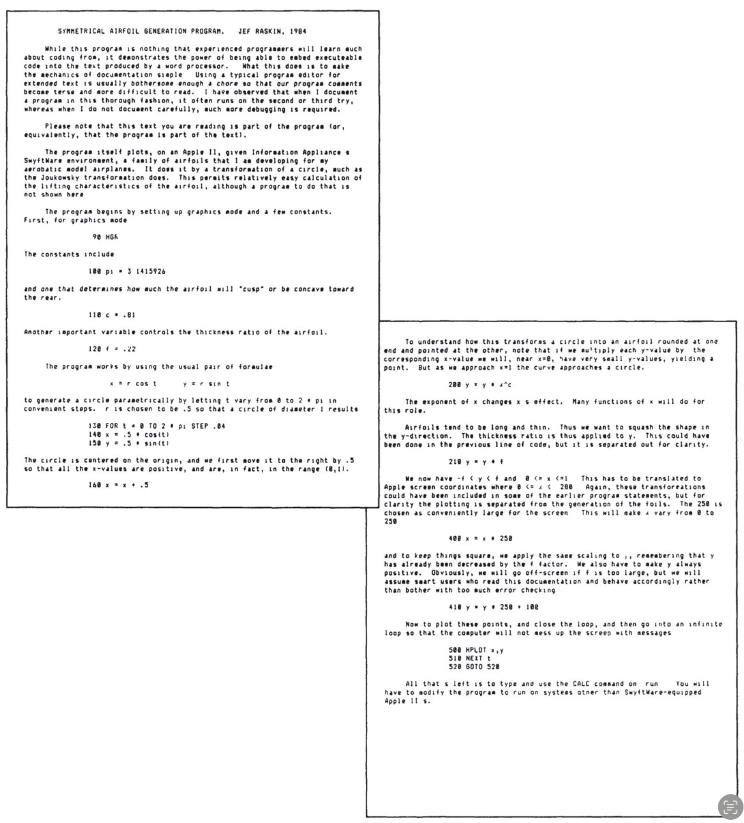
This program below demonstrates how Raskin embeds executable code into text that is produced by a word processor.