Scott Kim
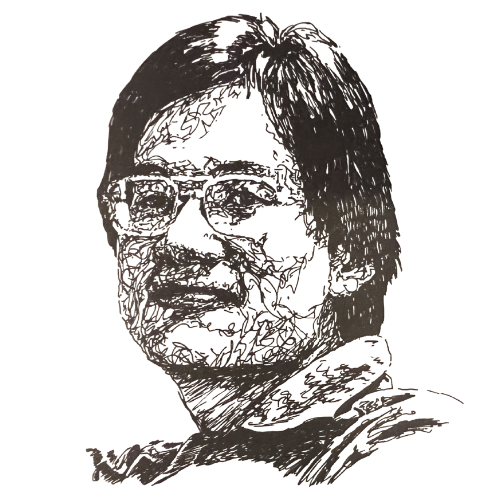
Scott Kim, the visual thinker, mathematician, and puzzle designer, who was a friend and colleague at Stanford of Doug Hofstadter, the author of Godel, Escher, Bach, while they conducted research at the Stanford AI Center in the late 1970s, was one of the most unconventional of the programmers I interviewed.
As a young man, he was collaborating with icons in the field such as John Warnock, Donald Knuth, David Fuchs and Jef Raskin on a visual technique he called Inversions. He wrote a book about it. To this day, Scott Kim designs puzzles in the spirit of MC Escher's art and Tetris. He has created thousands of puzzles for computer games and magazines. His first puzzles appeared in Scientific American in Martin Gardner's Mathematical Games column. He continues his creative pursuits, teaches, and advises startups on how to navigate the disruptive AI landscape. You can find more of Scott’s artwork and pursuits at www.scottkim.com.
Excerpts from the 1985 Interview in the Book
“Sitting next to a Macintosh at a large conference table, Kim and I talked for hours about his work and philosophy. Scott Kim is a soft-spoken, deliberate thinker; a dedicated student of the problem of how to change the computer so that it can be a much more direct, effective tool for everyone to use. His unusual background in graphic design, mathematics, and music helps him approach the problem from a visual perspective, a far different view than that of most engineers. Kim is a visual thinker above all. His inversions, which he can create on the spot at a moment’s notice, are a testament to his mental dexterity and flexibility. And one day he will also succeed in bringing to reality his vision of the computer that will work in a direct manner, with the same notation on screen and in the computer’s memory.”
“KIM: In 1975, I started a sequence of computer-music courses taught in the Stanford music department, and what was important, besides its being a good class, was that it was taught at the Stanford Artificial Intelligence Lab. It’s probably a common story that people tend to learn about computers not so much through classes as through some network of friends and people helping each other. And in my case, my breeding ground was the AI lab. It was a wonderful environment to learn in. It was physically isolated from the rest of the campus, situated in a run-down building in the foothills a few miles away. When you looked out, all you saw were hills and trees and blue sky.
INTERVIEWER: So was this CCRMA [Center for Computer Research in Music and Acoustics]?
KIM: Right. CCRMA at the time was the same as the Stanford AI lab. The music people used to be just a little appendage on the edge.
INTERVIEWER: Is it true that you were introduced to computers through music, basically?
KIM: Actually, my first experience with computers was in high school, but at Stanford I really started learning a lot about them. The sequence of computer-music courses gave me access to this wonderful community of people who were just out there hacking their hearts out for the pure love of it, and who would, at the drop of a hat, just spend the whole afternoon telling you what they were doing. That was a wonderful way to learn.”
Excerpt 1:
“INTERVIEWER: Do you think the process of creating software will simplify so almost anyone with a computer can create their own?
KIM: Basically, I expect the nature of programming to change… I expect that most people will not program in the usual sense as we understand it today. Even now, I believe there is no fundamental difference between programming a computer and using a computer. They’re very different activities, but they are on a continuum. When you type your name into a computer, that’s programming of a sort. The other type of programming through languages available today is a much more indirect activity. When more direct programming languages are available, then almost anyone will be able to build a program; it won’t feel much like programming any more. You won’t call them languages either.
INTERVIEWER: Okay, what will you call computer languages then? Or is it that you won’t even recognize them as computer languages, won’t even be conscious of these languages? Will they become like English?
KIM: The words we now use to describe all this will change. Alan Kay’s vision is that computers will be successful when we stop using the word computer. He would often say that in the early days of electricity a common belief was that some day everyone would have an electric motor in their house. That’s like computers today. When computers get small enough and cheap enough, they will disappear into the environment. You won’t even point your finger and say “that’s a computer,” since they will be all over the place. The computer is not successful until it disappears.”
Excerpt 2:
“KIM: Before Gutenberg, illustration and type were one and the same; they were inseparable. But afterward, the two disciplines became separate and diverged. Now that we’ve got the Macintosh, I can see a medium where they come back together again. In MacPaint there is no distinction between words and pictures. The characters in our alphabet actually started out as pictures. They are a human-made object. They did not come from nowhere and get fixed in stone. They have changed and evolved over the centuries. It is important to realize that all notations, whether music, or language, or computer languages, are just made up. They are symbols that can be changed. There is a choice. The ability to change notation empowers human beings.”
Excerpt 3:
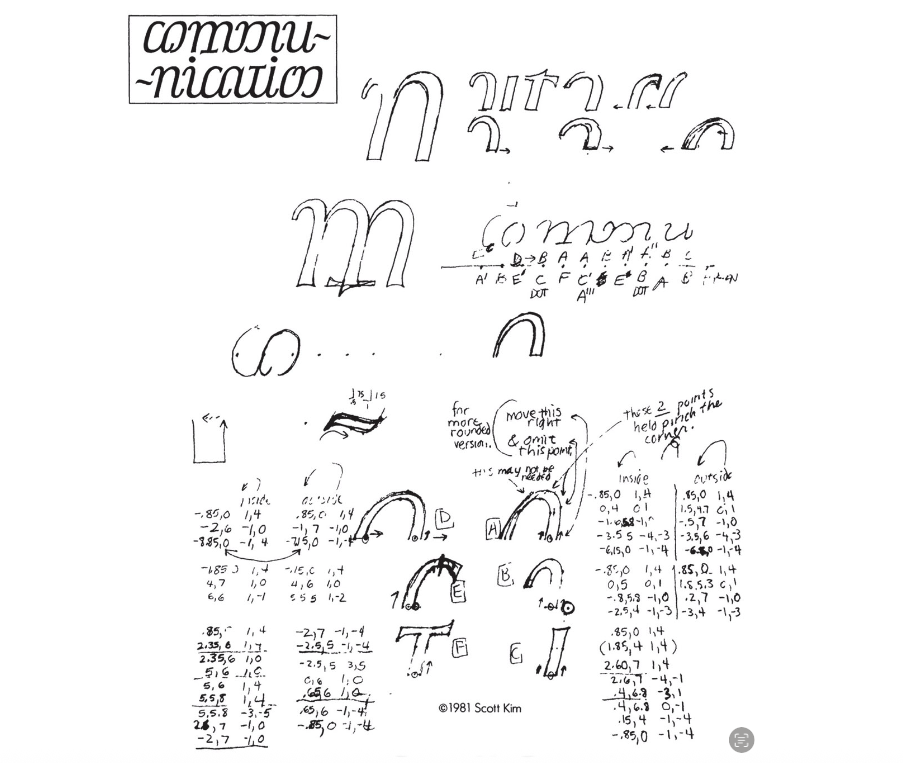
In this sketch, numbers plot points along curves and letters plan the composition of pieces into character shapes. Because of the symmetries among shapes, many pieces repeat. Shapes were planned on paper first, then turned interactively on the screen. The final image was produced on a laser printer. The Appendix (pages 372–373) contains more sketches from Kim.