Dan Bricklin
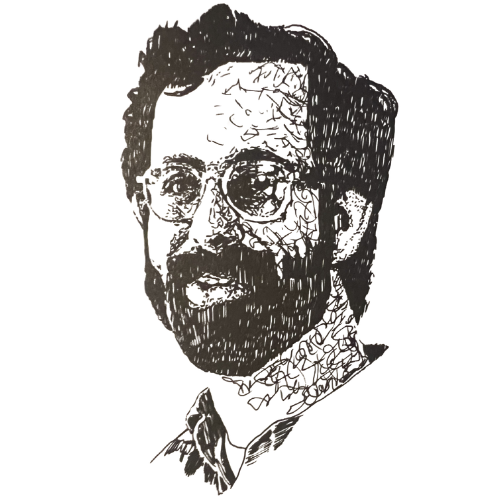
Dan Bricklin is best known for codeveloping VisiCalc, the first electronic spreadsheet, a groundbreaking program widely credited for fueling the rapid growth of the personal computer industry. Listening to his story of how the concept for a spreadsheet took shape in his mind is remarkable. In the interview he also shares how he navigated through the peaks and valleys of pursuing an idea in the rough and tumble of the rapidly growing and changing PC business. He has continued his work as a force in the computer world through his various product and business ventures, all seeking to make working with computers and developing software easier for the rest of us. For his outstanding contributions to the field of computer science, he has won numerous awards and honors.
Excerpts from the 1985 Interview in the Book
“I met with Dan Bricklin at his suburban Boston home. He works out of an extra bedroom, which serves as the office for his new, one-person company, Software Garden. With a new philosophy stemming from his experience with the rise and fall of Software Arts, Dan Bricklin is starting over. This time it is not with the innocence, unleashed enthusiasm, and incredible energy of his first venture, but rather with a certain degree of caution, insight, and control. As Bricklin says, his intent is not to run a ranch or tend a farm, but to cultivate a garden of software, just like a garden in the backyard; one that is sufficient to meet his needs and from which he can gain pleasure and satisfaction.
It is evident that Bricklin’s past experience with VisiCalc has weighed upon him. He is a soft-spoken, easygoing, intelligent man. In a careful, reflective manner, Bricklin discussed his experience developing the VisiCalc spreadsheet program and running Software Arts, and shared his ideas of what he looks forward to achieving with his new program and his new company.”
“INTERVIEWER: Do you think there will continue to be these small types of software operations? Or will the software industry be dominated by a handful of huge companies?
BRICKLIN: No. People are writing their own programs. Anybody who uses a spreadsheet is writing their own programs; it’s just that the language is different now. Bob Frankston likes to tell a story about the telephone company. Back in the twenties they said that telephones were growing so fast that by 1950 everybody in the country would have to be an operator. By 1950 people said, “Ha, they were wrong.” Well, it turned out they were right, because everybody was an operator; they just had dial telephones. The technology had made it easy enough to be an operator. Well, that’s the same thing with programming. We’re just making the users do more and more of the programming themselves, but they don’t know it. Using different style sheets with Microsoft Word is doing programming; using spreadsheets is doing programming. There is an inherent cottage-industry component to programming. We constantly improve the tools that are available, the operating systems, environments, languages, and all. Consequently, an individual can always do a lot more than he used to…]
It’s like writing. An encyclopedia requires a large staff; an individual can’t do it all. Some operating systems nowadays are encyclopedic. But there’s also always the short story, the novel, and the poem. Those are useful in their own way, though they may seem simple and trivial to do. Any large company could have a million programmers working on some idea to produce a better one, but they don’t because it doesn’t work that way. The economics aren’t there. Sometimes the idea behind a program is one small creative effort. Just like in a short story, one little twist in the plot is the whole idea behind it. The same thing is true of the programs. In terms of marketing, you do need a large marketing organization. But there’s a variety of ways to do that, just like with books. You can self-publish or you can go to a publisher. With movies, you have the distribution company that takes care of it. If you look at the biggest sellers in the software industry, in general they were written by very few people. 1-2-3 was in essence written and designed by two people, one programmer and one partial programmer; VisiCalc, the same way. dBASE, I think, was originally written by pretty much one person. Paradox was written by two people. That’s the way things are done.”
Interview Excerpt:
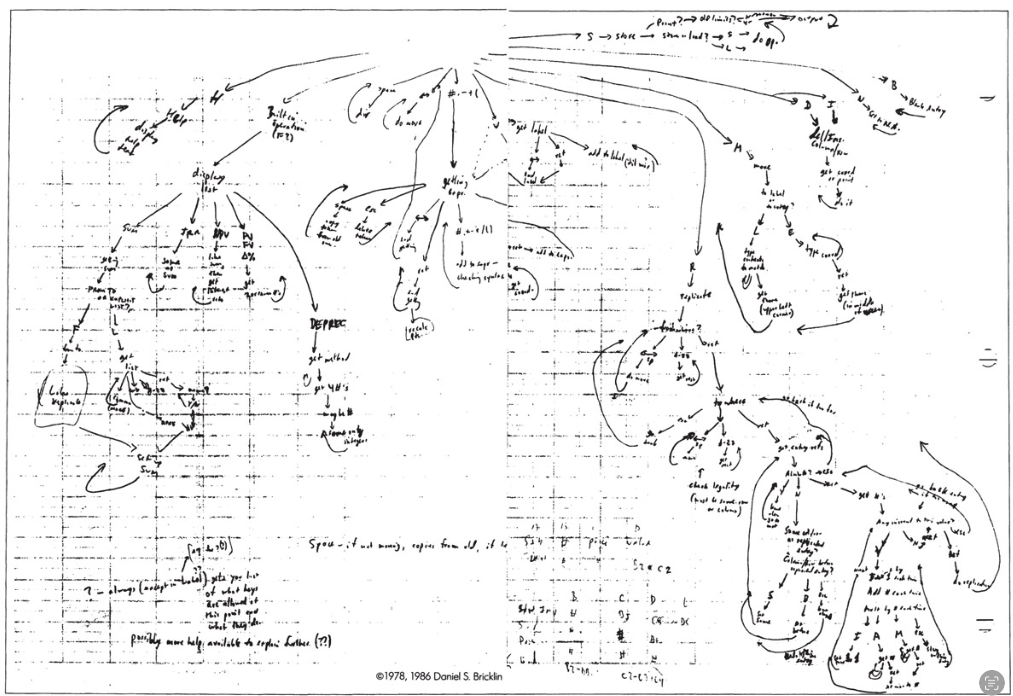
Bricklin’s original command diagram for VisiCalc from November, 1978. The diagram was written on a piece of spreadsheet paper (hence the grid in the program) that Bricklin used in business school.