Toru Iwatani (岩谷徹)
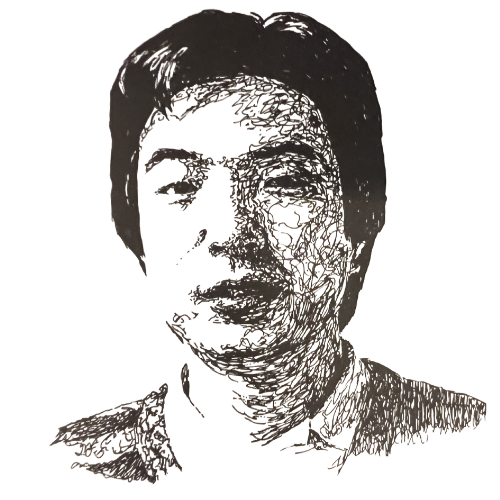
The young legendary PacMan game designer I first met in 1985 in Tokyo, went on to lead the development of many other successful games for NAMCO until 2007. He also worked in film as a director and writer for Pixels (2015), Quester (1987) and Shadow Labyrinth (2025.) He currently works as an emeritus-professor at Tokyo Polytechnic University In addition to creating characters for games, Iwatani also has gone on to become a character in film. He was portrayed in the sci-fi comedy adventure Pixels by actor Denis Akiyama while Iwatani himself has a cameo as an arcade repairman.
Excerpts from the 1985 Interview in the Book
“Geoff Leach, a friend and associate in Tokyo, sent me a lively telex one day, saying he had learned the name of the designer of Pac-Man through his boss, Mr. Imaizumi, who happened to be in a study group with the designer. He thought he might be able to arrange an interview for me. I fired back a telex, expressing my delight at the prospect. In Japan, the individual responsible for creating or designing a product is often not singled out and recognized. The group or company receives the credit, and the individual, although known in certain circles, remains inaccessible and unidentified. In this case, due to the personal nature of the contact, the interview was granted. Mr. Leach and I took the subway to the outskirts of Tokyo to the offices of NAMCO. After reaching our stop, we wandered down narrow, busy streets in a shop-filled neighborhood until we came upon a striking brown marble building. The success of Pac-Man had obviously served the company well.
We pushed through a set of double doors to enter the large white-marble lobby, where we were immediately welcomed by a gesticulating lady robot receptionist. She was decorated in pink and cream colors, with a nice pink helmet-like hat and blue eyes, and she had a shapely feminine figure. There was not another soul around. We paused, looking at her from a distance behind the counter. As we moved further into the lobby, she motioned us up to the counter. A computer terminal on the counter next to her flashed “WELCOME TO NAMCO,” and prompted us to look through a telephone directory and call the person we wished to see. We stood at the counter quite amused and somewhat baffled by all this, when the public relations director came up to greet us and ushered us into a conference room.
He entered the room, and we all stood and greeted, bowed, and exchanged business cards. Mr. Iwatani was a tall, striking man with a quiet, yet forceful, manner. He wore a light yellow polo shirt and wide-wale corduroy slacks. It was explained that the interview would be conducted in Japanese, with Mr. Leach acting as the interpreter. Iwatani spoke carefully and thoughtfully in his deep voice, and as he expressed his thoughts, he scribbled notes and sketches in his calendar notebook to illustrate his points.”
“INTERVIEWER: How did you first become interested in computers and game design?
IWATANI: I must tell you, I don’t have any particular interest in them. I’m interested in creating images that communicate with people. A computer is not the only medium that uses images; I could use the movies or television or any other visual medium. It just so happens I use the computer…I had no special training at all; I am completely self-taught. I don’t fit the mold of a visual arts designer or a graphic designer. I just had a strong concept about what a game designer is—someone who designs projects to make people happy. That’s his purpose.
INTERVIEWER: What was the thinking behind the design of Pac-Man?
IWATANI: First of all, the kanji word taberu, to eat, came to mind. Game design, you see, often begins with words. I started playing with the word, making sketches in my notebook. All the computer games available at the time were of the violent type—war games and space invader types. There were no games that everyone could enjoy, and especially none for women. I wanted to come up with a “comical” game women could enjoy. The story I like to tell about the origin of Pac-Man is that one lunch time I was quite hungry and I ordered a whole pizza. I helped myself to a wedge and what was left was the idea for the Pac-Man shape.
INTERVIEWER: What did you intend the character of Pac-Man to be like?
Pac-Man’s character is difficult to explain even to the Japanese—he is an innocent character. He hasn’t been educated to discern between good and evil. He acts more like a small child than a grown-up person. Think of him as a child learning in the course of his daily activities. If someone tells him guns are evil, he would be the type to rush out and eat guns. But he would most probably eat any gun, even the pistols of policemen who need them. He’s indiscriminate because he’s naïve. But he learns from experience that some people, like policemen, should have pistols and that he can’t eat just any pistol in sight. [Iwatani begins sketching diagrams of curves with points on his calendar notebook. See the illustrations at the beginning of this interview.]
INTERVIEWER: What was the most difficult part of designing the game?
IWATANI: The algorithm for the four ghosts who are the enemies of the Pac- Man—getting all the movements lined up correctly. It was tricky because the monster movements are quite complex. This is the heart of the game[…]”
Interview Excerpt:
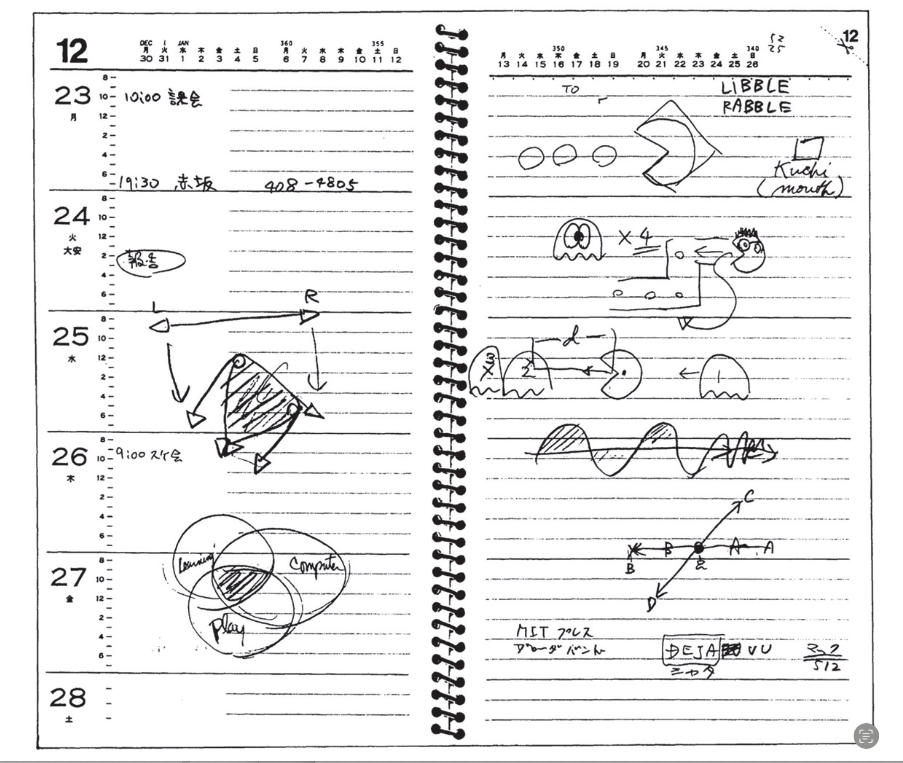
During the course of the interview Iwatani drew sketches and diagrams in his calendar notebook. They illustrate how the shape of Pac-Man evolved and how the ghosts move in relation to Pac-Man as described in the full interview.